
When most teams look at underperforming paid media, they immediately assume something is wrong with the creative or the targeting. That’s the obvious place to look, and in some industries, it’s often true.
In agriculture, though, the problem usually sits somewhere less exciting.
More often than not, it comes down to tracking.
We recently worked with an ag client spending between $10,000 and $20,000 per month on Meta, along with additional budget on Google. Their cost per lead was sitting at roughly $212. After a handful of changes, that number dropped to $15. What’s more interesting is that we didn’t overhaul their campaigns, launch new creative, or rebuild their targeting strategy. We simply fixed the underlying system that was feeding data into the platforms.
The Pattern We See in Ag Accounts
After auditing a lot of ag ad accounts (across ag lending, input companies, software scales ups, and livestock-related brands), you start to notice a pattern. The same issues show up over and over again, regardless of budget or sophistication.
Conversion tracking is often incomplete or unreliable. CRM data, if it exists, rarely makes its way back into platforms like Meta or Google. Campaigns are typically optimized around surface-level actions like form fills rather than meaningful business outcomes. And while everyone acknowledges seasonality in agriculture, very few accounts actually reflect it in how campaigns are structured or measured.
Individually, none of these problems seem catastrophic. But together, they create a situation where the ad platforms are making decisions based on weak or misleading signals.
How Good Campaigns Go Sideways
It’s entirely possible to do a lot of things right and still get poor results.
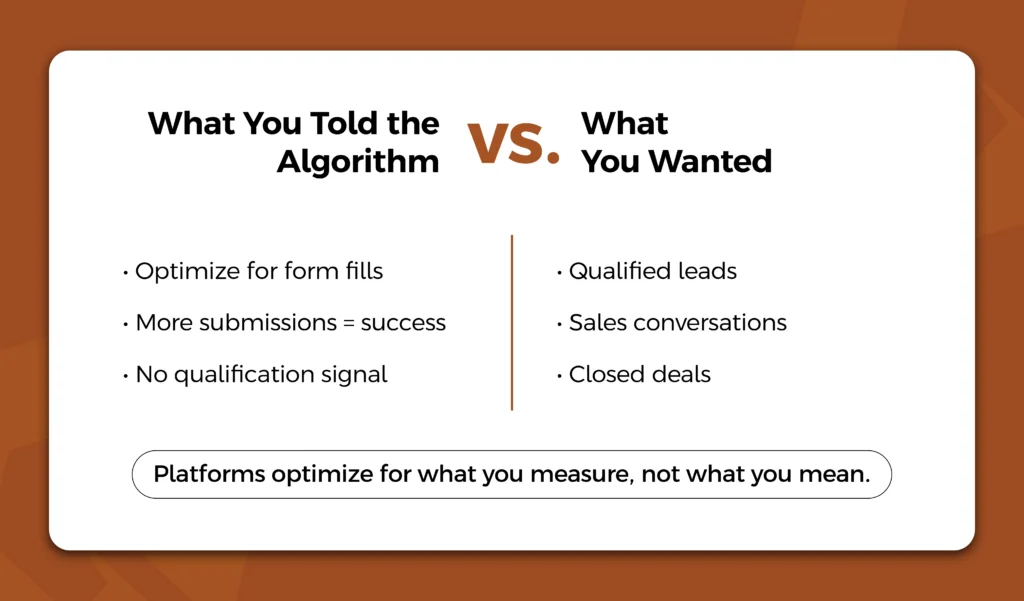
You can invest in strong creative, spend time refining your messaging, and build thoughtful targeting. On the surface, everything looks dialed in. But then the campaign is told to optimize toward something like a form submission.
From the platform’s perspective, that’s the goal. It will go out and find more people who are likely to complete that action. The problem is that not all form fills are equal. Some represent real potential customers, while others are unqualified, low-intent, or even automated spam.
If the platform isn’t given any additional context, it treats all of those conversions the same. Over time, it learns to prioritize volume over quality because that’s the signal it’s been given. That’s how costs creep up while actual business outcomes stagnate… or get worse.
What We Changed (And What We Didn’t)
In this case, the account itself was in decent shape. The creative was solid, the messaging was working, and the targeting wasn’t fundamentally broken. That allowed us to focus on a couple of high-impact changes instead of starting from scratch.
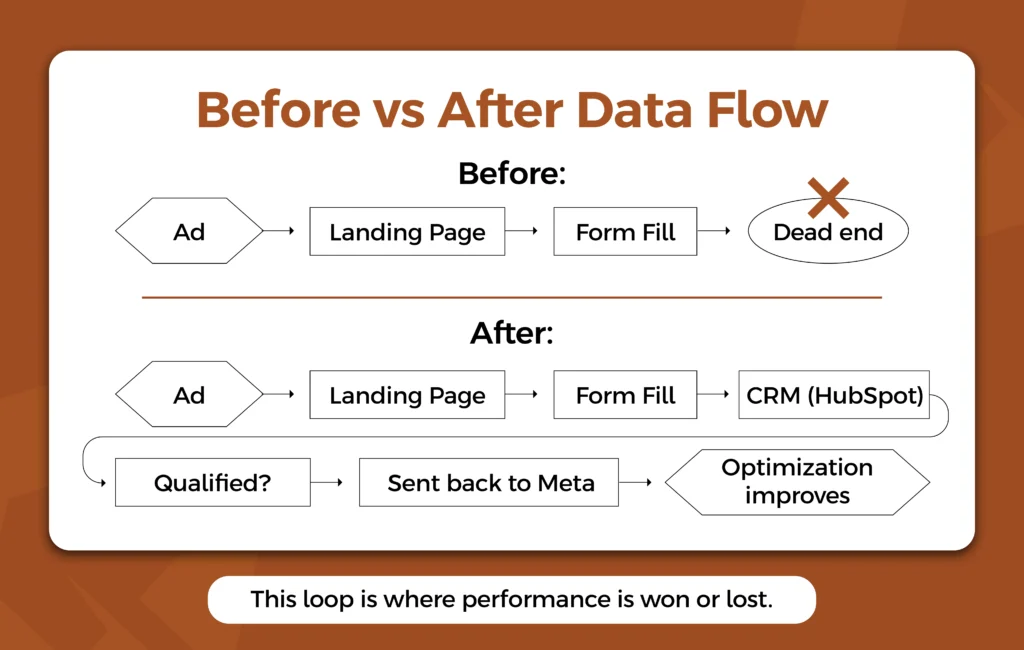
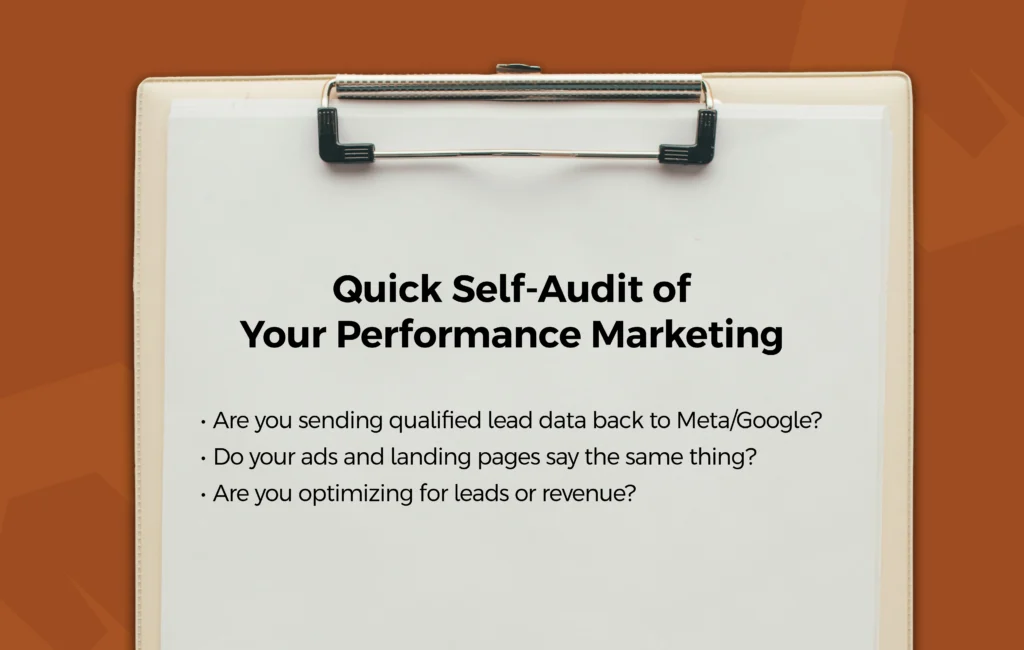
The first was connecting the client’s CRM data back into Meta through offline conversion tracking. They were using HubSpot, but none of that downstream information—like whether a lead was qualified or moved forward—was being fed back into the platform. Once that connection was in place, Meta could begin optimizing toward leads that actually resembled customers, rather than just anyone who filled out a form.
The second change was tightening the alignment between the ads and the landing page. The ads themselves were performing well, so we left them alone. However, the landing page didn’t fully match the promise and language of the ads. By bringing those into alignment, we reduced friction and made it easier for the right prospects to convert.
Neither of these changes is particularly flashy, but together they significantly improved the quality of the signals being sent back to the platform.
The Result—and the Reality Behind It
Following these updates, the client’s cost per lead dropped from $212 to $15. That’s a dramatic shift, and it’s the kind of number that naturally grabs attention.
At the same time, it’s important to keep that result in context. That $15 cost per lead is unlikely to hold forever, and it doesn’t need to. As the platform continues to optimize and expand reach, costs will likely rise. The difference is that those costs are now tied to higher-quality leads.
That’s a much healthier place to be.
Rethinking What “Good” Performance Looks Like
One of the more common traps in ag marketing is an overemphasis on lowering cost per lead. While efficiency matters, it’s not the metric that ultimately drives business outcomes.
In industries like agriculture, where deal sizes are often large and customer relationships are long-term, a higher cost per lead can be completely justified if those leads are more likely to convert. If your cost per lead increases from $50 to $100, but your close rate also improves significantly, the overall return is better.
In this particular case, the client offers a high-value, sticky product with strong lifetime value. They don’t need the cheapest leads — they need the right ones. Once that shift in focus happens, the way campaigns are measured and optimized starts to change as well.
Why This Matters More Than Ever
Ad platforms have become increasingly sophisticated, especially when it comes to targeting. Meta, in particular, leans heavily on your creative and messaging as primary signals for who should see your ads. That’s a powerful capability, but it also raises the stakes.
These systems are only as effective as the data they receive.
If your conversion tracking is incomplete, or if you’re feeding back low-quality signals, the platform will still optimize, it just won’t be optimizing for the outcome you actually care about. On the other hand, when you provide clear, accurate feedback on what a good lead looks like, these systems can become incredibly effective at finding more of them.
Where the Focus Shifts Next
Once lead quality improves and volume increases, the conversation naturally moves beyond marketing.
Now the questions become operational. Can the sales team handle the increased flow of leads? Are follow-up processes consistent and timely? Is the CRM structured in a way that supports clear reporting and decision-making?
In this case, the client has already begun shifting from a pure lead generation focus to improving qualification and internal processes. That’s typically a sign that the marketing foundation is doing its job.
The Bottom Line
For ag companies investing meaningful budget into paid media, the biggest opportunity is often not a new campaign or a more creative ad. It’s making sure the underlying systems are set up to send the right signals back to the platforms doing the optimization.
Without that foundation, even well-run campaigns can struggle.
With it, performance tends to improve quickly, and more importantly, sustainably.
If you want to learn more about the specific tactics & implementation mentioned in this blog, check out the resources below: