

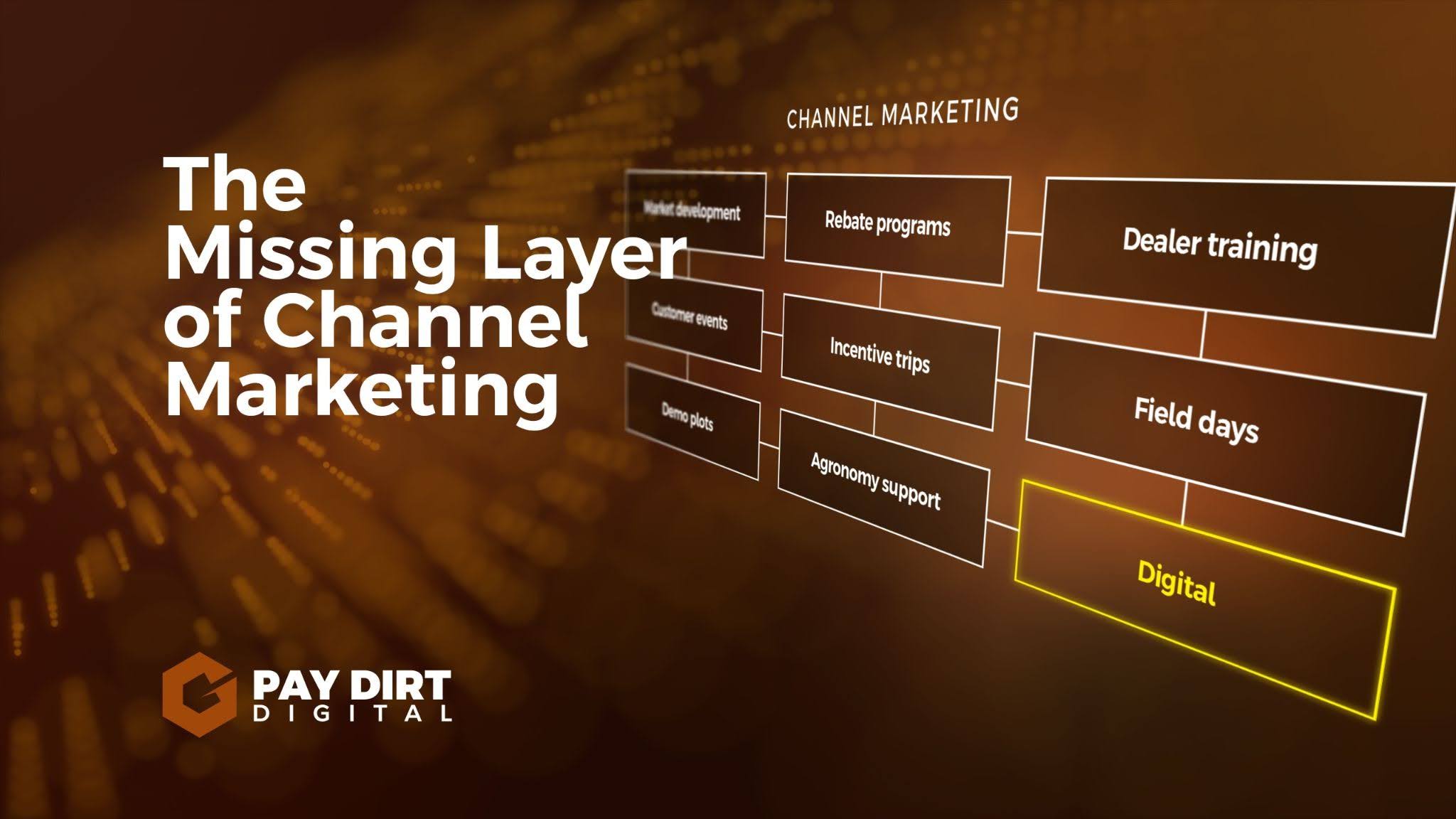
Agricultural input brands have spent decades getting really good at supporting their channel.
Every year, millions of dollars go toward market development programs, rebate programs, retailer training, customer appreciation events, incentive trips, field days, demonstration plots, agronomy education, and countless other initiatives designed to strengthen relationships with dealers and retailers. Those investments matter. They build trust, strengthen partnerships, and ultimately help products move through the channel.
But here’s the question I don’t hear asked very often:
If you’re already investing millions in your channel, why isn’t digital part of that investment?
To be clear, this isn’t an argument against the investments already being made. Incentive programs work. Customer appreciation events work. (If you’re offering a retailer and their customers a trip somewhere warm in February, you’re probably doing something right.) This is simply an argument that digital deserves a seat at the same table.
Not as a replacement for what already works.
As another way to help your channel partners create demand before the sales conversation ever begins.
And we’ve already seen this sort of digital enablement work [here’s where I insert the plug to come talk to us to learn more…😉]
Great channel marketing gets products into the market. Great channel demand generation gets them into the conversation.
Ask any ag retailer and they’ll share that they service products from dozens and dozens of manufacturers and input brands. Getting into distribution is an important milestone, but it isn’t the finish line.
The real competition starts once the grower has an agronomic need.
Every agronomist has dozens of recommendations they could make depending on the crop, the field, the weather, previous applications, pricing, and about a hundred other variables that seem to change weekly. When a grower asks, “What would you recommend on these 10 acres based on these specific conditions?” they’re not looking for every product in the warehouse. They’re looking for a trusted recommendation.
That’s the conversation every input brand wants to be part of.
Digital isn’t going to replace that conversation. Nor should it. The value of the retailer has always been local knowledge, trusted relationships, and agronomic expertise. What digital can do is help ensure your brand isn’t being introduced for the very first time at that moment.
As we’ve talked through this approach with clients and thought about where it fits, we’ve realized it doesn’t neatly fit into “channel marketing” or “digital demand generation.” It sits somewhere in between.
We’ve started calling it Channel Demand Generation because that’s exactly what it is: using digital marketing to help channel partners create local demand before the sales conversation ever begins.
It’s not replacing traditional channel marketing.
It’s extending it into a place where many input brands haven’t invested nearly as much attention.
And we’re already seeing the impact it can have across different corners of agriculture, not just the Ag input supply chain.
What Channel Demand Generation actually looks like
Let’s use a simple example.
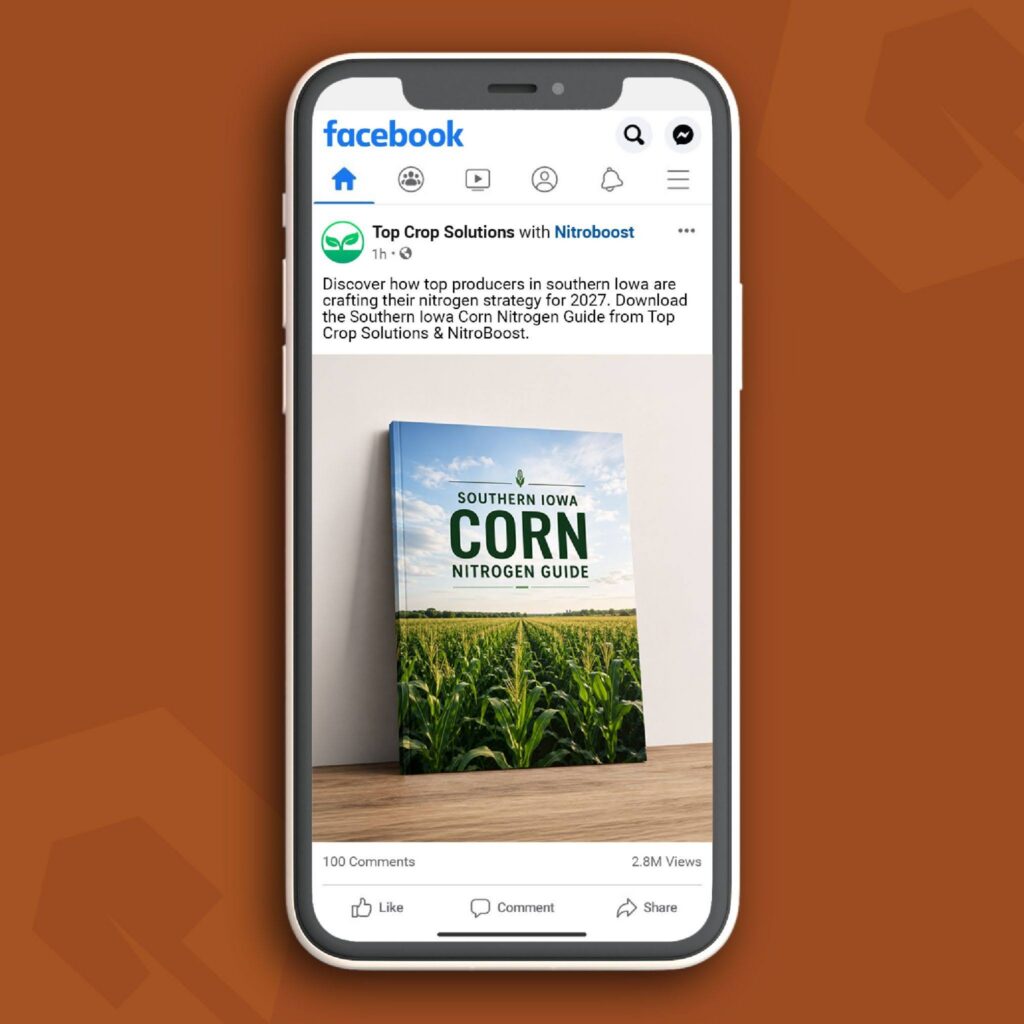
Imagine Brand X sells a nitrogen-related product through Ag Retailer Y, which serves growers across southern Iowa.
A traditional digital campaign might promote Brand X’s product nationally with messaging around nitrogen management and link to a product page. There’s nothing inherently wrong with that approach. It builds awareness, and awareness has value.
A Channel Demand Generation campaign starts from a different question:
How do we help Ag Retailer Y have more conversations about Brand X’s product this spring?
Instead of creating another generic product ad, Brand X and Ag Retailer Y build a Southern Iowa Corn Nitrogen Guide filled with practical recommendations relevant to growers in that region. The guide is promoted through a co-branded Meta campaign targeted only to growers within Ag Retailer Y’s geography or those who are following the retailer’s location Facebook page.
Now the message feels different.
It’s local.
It’s educational.
And perhaps most importantly, it feels like something created for my area instead of every area.
A grower downloads the guide while scrolling Facebook one evening. A couple of weeks later they’re meeting with their agronomist to talk through nitrogen plans.
Instead of hearing about Brand X’s product for the first time (or maybe even the 100th time), they’re continuing a conversation that already started.
That’s a subtle difference, but it’s an important one.
Brand X didn’t simply create product awareness.
It created local awareness in partnership with the retailer where the buying conversation was always going to happen.
And at Pay Dirt Digital, we’ve seen engagement rates quadruple on campaigns where this strategy is deployed.
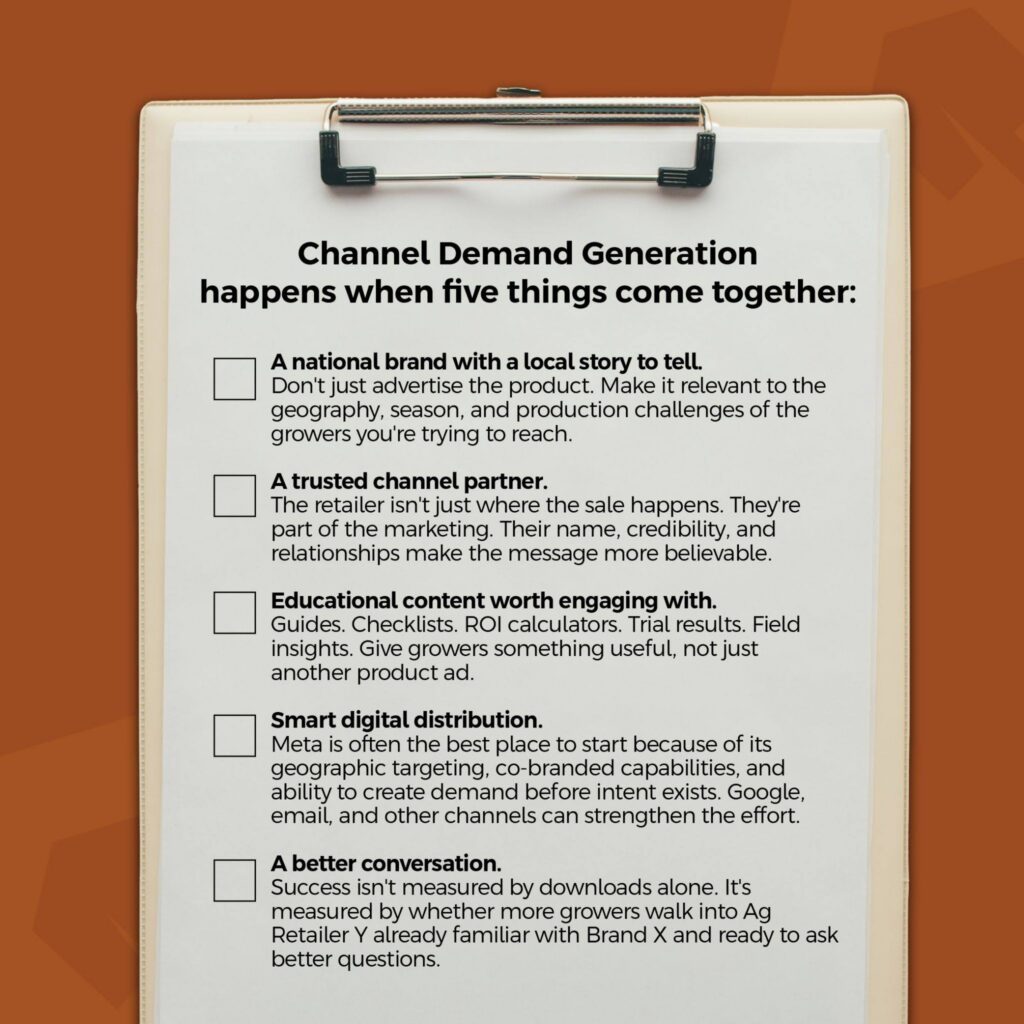
Why Meta is uniquely positioned for this
The concept of Channel Demand Generation isn’t limited to Meta.
Google Search has an important role to play, especially when growers are actively researching products or searching for a nearby retailer. Email helps continue the conversation after someone engages. AI is introducing whole new ways that growers are researching. There are opportunities across nearly every digital channel.
But Meta stands out because it’s exceptionally good at creating demand before intent exists.
Brands can target growers within a specific retailer’s geography, collaborate with local retailer Pages, tailor messaging around regional agronomic challenges, and promote educational content that feels relevant instead of generic.
That’s a very different strategy than running one national campaign and hoping it resonates from Georgia to North Dakota.
Agriculture is still local.
Our marketing should acknowledge that.
Better conversations. Better support. Better insight.
One of the biggest challenges in channel marketing has always been attribution.
No dashboard is ever going to pop up and tell you, “Good news! A grower just asked their agronomist about your product at 9:17 this morning.” Agriculture simply doesn’t work that way.
That doesn’t mean we should settle for having no visibility at all.
Channel Demand Generation gives brands an opportunity to combine trusted retailer relationships with measurable digital engagement. You’ll never connect every recommendation back to a campaign, but you can begin understanding which markets engaged with your content, which retailers saw stronger local participation, and where digital activity aligned with increased interest or brand lift.
It’s not perfect attribution. The digital metrics speak for themselves, but connecting digital engagement to sales is still difficult when the channel is the primary distribution.
That’s where engaging with sales leadership and getting qualitative feedback from the field will help connect the dots.
The opportunity isn’t replacing channel marketing. It’s strengthening it.
The best channel programs have always invested in relationships. That shouldn’t change.
Keep investing in market development programs. Keep funding incentive programs. Keep hosting field days, rewarding retailers, and training retail agronomists.
Those investments create stronger partners.
But digital creates another opportunity to help those partners succeed.
The brands that stand out over the next decade won’t just be the ones with the biggest marketing budgets. They’ll be the ones that recognize supporting the channel doesn’t stop with training, incentives, and events.
The strongest channel marketing doesn’t just support partners.
It helps them create demand.